What Perfume Notes Can Tell You—and What They Leave Out
Use a note list to narrow your options, then let the fragrance itself answer the questions the list cannot.

Two perfumes can list rose, vanilla and sandalwood and still smell quite different. One might feel airy and dry; another might be soft and sweet. A note list is useful, but it is closer to a description than a recipe you can reconstruct.
When you read one, the best question is not “Do I like every ingredient here?” It is “Does this give me a sensible reason to try the fragrance?”
Start with a direction
Words such as citrus, floral and woody can help you find a starting point. If you enjoy sharp, bright smells, a citrus-led description may catch your attention. If sweet scents tend to feel heavy to you, look more closely at how sweetness is described before ordering a sample.
These are clues, not promises. “Fresh” can mean a tart citrus opening, a green impression or something that reminds a reviewer of clean laundry. Those are different experiences, even when a shop groups them together.
Top, heart and base are a way of describing development
A top-note description usually focuses on the opening. Heart notes describe the character as the fragrance develops, while base notes describe elements associated with its later impression. You do not need to catch each stage on a timer.
During a test, write down what you notice at the start and what remains later. “Sharper at first, softer after lunch” is a perfectly useful observation. There is no need to borrow a vocabulary that makes your own notes harder to understand.
A note is not always a literal ingredient
A brand may describe a smell through a familiar reference. A listed impression does not, by itself, tell you the complete formula or the source of every material. Treat the consumer-facing note list and the ingredient label as different pieces of information.
If you need to check a particular ingredient, use the product label and ask the manufacturer. A poetic description is not the right tool for that question.
Leave room to be surprised
Try one fragrance that matches your usual preferences and one that almost does. A rose scent with a dry finish might suit someone who normally avoids sweet florals. The point of reading notes is to make sampling more focused, not to rule out everything unfamiliar.
After testing, keep your own sentence about the fragrance. That sentence will be more useful next time you shop than a long list you cannot connect to an actual smell.
Further reading: The Fragrance Foundation France: Understanding perfume notes.
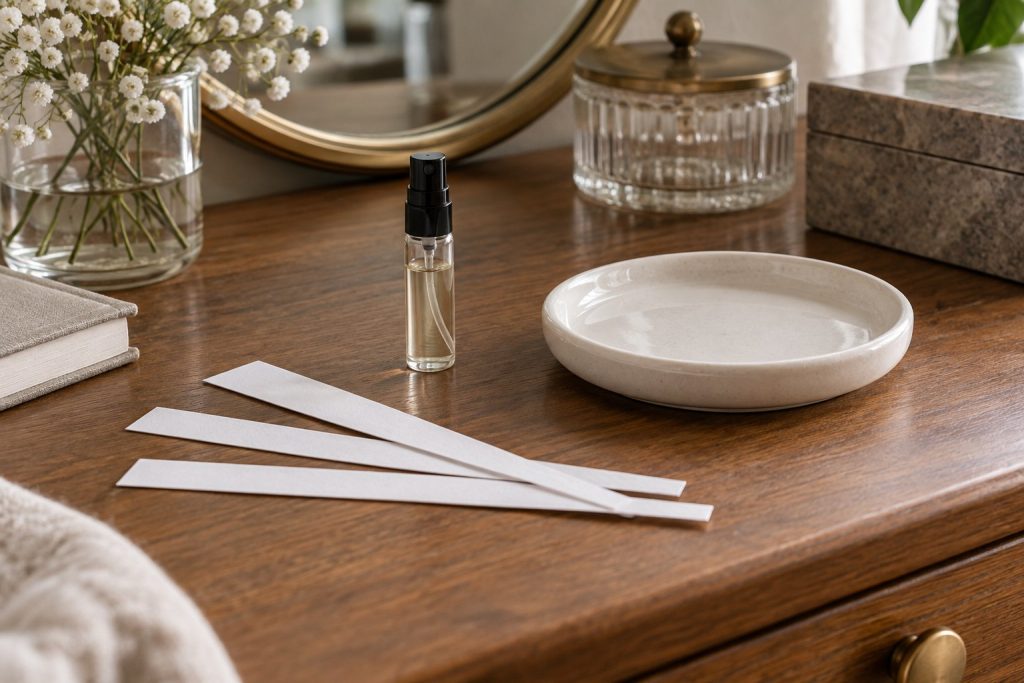
Illustration generated with AI; the bottles shown are generic.
From our shop
If you are comparing inspired fragrances, our Fragrentis shop lists the bottle sizes and scent descriptions for its products. Use those descriptions as a starting point, rather than a promise of how a fragrance will smell on your skin.
Browse the Fragrentis collection
This journal is published by the team behind Fragrentis. This link leads to our own shop.